Temple Illustration
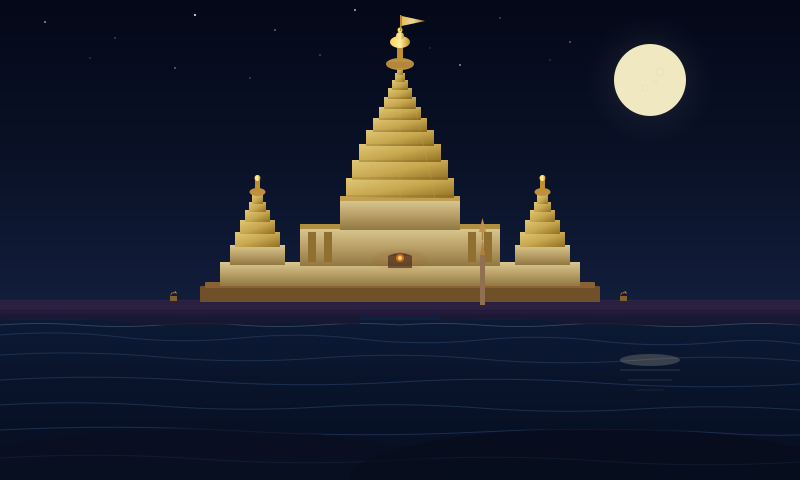
Photo gallery coming soon — curated images of Somnath Jyotirlinga and its surroundings.
About
Somnath Jyotirlinga stands on the western coast of Gujarat at Prabhas Patan, where the Hiran, Kapila, and Saraswati rivers meet the Arabian Sea. It is the first among the twelve Jyotirlingas in traditional enumeration and one of the most historically layered pilgrimage sites in India. The shore temple, rebuilt seven times after successive destructions, faces westward toward the open ocean — a rare orientation that has given rise to the saying that there is no landmass between Somnath and the South Pole along that longitudinal axis.
The Shiva Purana identifies Somnath as the site where Soma, the moon god, performed penance after being cursed by his father-in-law Daksha. The curse had caused the moon to wane continuously; after Shiva's intervention, waxing and waning were established as the moon's permanent cycle. Somnath — "Lord of the Moon" — thus became the presiding deity of the lunar cycle itself. The temple's location near the Prabhas tirtha mentioned in the Mahabharata adds another layer of sanctity: it is here that Krishna, after the Kurukshetra war, is said to have departed from the world.
The present temple, consecrated in 1951 under the direction of Sardar Vallabhbhai Patel after independence, is built in the Chalukya style with a 15-metre shikhara. The reconstruction was itself a national act of reclamation. The Jyotirlinga is housed in the Garbha Griha at ground level, and an eternal flame (Akhand Jyot) has been maintained within the complex. Sound and light shows at the complex recount the temple's history to modern pilgrims. The most auspicious time to visit is Shivratri and Kartik Purnima, when the sea-facing ghats glow with thousands of lamps. Devotees may offer Shiva Seva inspired by this sacred kshetra.
