Free tools
About this vrat
Mahalaxmi Vrat (महालक्ष्मी व्रत) is a sixteen-day vrat observed from Bhadrapad Shukla Ashtami to Ashwin Krishna Ashtami in honour of Maha Lakshmi in her sixteen forms (Sodasha Lakshmi). Among all the Lakshmi vrats in the Hindu calendar, this is the most rigorous and most celebrated — the vrat that, according to the Bhavishya Purana, was prescribed by Lord Krishna himself to Yudhishthira when the Pandavas had lost everything in the dyut sabha (game of dice) and were beginning their long exile.
The story Krishna tells Yudhishthira places the vrat in mythic perspective: when Indra had lost his kingdom to the asuras and his wealth, dignity, and consort had departed, he turned to Vishnu in despair. Vishnu instructed him in this very vrat — sixteen days of austerity in honour of Mahalakshmi, with sixteen knots tied in a sacred thread, sixteen offerings of every kind, and sixteen days of unbroken devotion. Indra observed it; Lakshmi returned to the heavens; Indra recovered his throne. Krishna, telling Yudhishthira the story, prescribes the same vrat: the Pandavas, having lost everything, must observe it to recover what is rightfully theirs.
The vrat is therefore the Lakshmi-vrat of last resort and of greatest hope: kept by households that have faced major loss — financial, marital, social, dignitarian — and that wish to call Lakshmi back into their lives. The form is rigorous (sixteen consecutive days, sometimes with nirjala or partial fasts) but the legend behind it carries an extraordinary weight: even the gods, even the Pandavas, have observed it.
The defining ritual element is the sodasha-granthi (sixteen-knot) thread — a sacred thread (often raw cotton dyed turmeric-yellow) tied with sixteen knots, each knot consecrated with mantra. The thread is worn on the wrist (right wrist for men, left for women) for the duration of the vrat; sixteen offerings are made daily before Mahalakshmi; the Mahalaxmi Stotra is recited; and on the sixteenth day the vrat is concluded with an elaborate udyapan.
Mahalaxmi Vrat (16 days) — Katha
The legendary story recited as part of the vrat. Read aloud during the morning puja.
The Mahalaxmi Vrat Katha begins with the gods in distress. The asuras, led by Bali, had defeated the devas in battle; Indra had lost his throne, his wealth, and his dignity; even his consort Sachi had begun to slip from him. The heavens, without Lakshmi, were turning to ruin. Indra, in his despair, went to Lord Vishnu and begged for guidance.
Vishnu, who had been waiting for Indra to come to him in this state of true humility, smiled and said: "Indra, you have ruled too long with the assumption that Lakshmi is yours by right. She is no one's by right. She comes to those who call her with sincerity, who hold her with humility, who serve her with sustained devotion. There is a vrat — the Mahalaxmi Vrat — that I will teach you. Observe it for sixteen days, beginning on Bhadrapad Shukla Ashtami. Tie a sacred thread with sixteen knots upon your wrist; offer her sixteen of every prescribed item every day; recite the Mahalaxmi Stotra without break; do not allow anger or pride to enter your heart; on the sixteenth day, perform the udyapan with the feeding of sixteen brahmins."
Indra observed the vrat exactly. The first day, the second day — nothing seemed to change. By the eighth day, Indra felt his heart begin to settle; the pride that had ruined him began to fall away. By the twelfth day, Sachi — who had been quietly observing him — returned to his side. By the sixteenth day, when Indra performed the udyapan with the feeding of sixteen brahmins and the gifting of sixteen of every kind of item, Lakshmi herself appeared before him. She told him: "Indra, you have not won me back; you have remembered how to host me. From this day, every household that observes this vrat with the same sincerity will receive my visit. Whoever ties the sodasha-granthi thread, whoever recites the stotra without break, whoever holds humility in their heart through the sixteen days — that household will not lack for me."
Indra recovered the heavens. The asuras were defeated; the devas regained their dignity; Sachi remained. The vrat became the Mahalaxmi Vrat as taught by Vishnu to Indra, and was observed by countless gods and rishis in the ages that followed.
The katha then leaps forward to the Mahabharata. After the dyut sabha, after Draupadi's humiliation, after the Pandavas had been stripped of their kingdom and forced into exile, Yudhishthira sat in the forest in despair. Krishna came to him one day and asked the cause of his sorrow. Yudhishthira said: "Madhava, we have lost everything — kingdom, wealth, dignity, even Draupadi was nearly lost to us in that hall. How will we ever recover what we have lost?"
Krishna told him the story Vishnu had told Indra. He prescribed the same vrat — the same sixteen days, the same sodasha-granthi thread, the same offerings. Yudhishthira observed it with full sincerity, with Draupadi observing it alongside him. Within the year, the Pandavas had begun their gradual recovery: alliances reformed, weapons recovered, the path to Kurukshetra opened. The vrat had carried them.
The katha closes with the affirmation that whoever observes the Mahalaxmi Vrat for sixteen days, with the sodasha-granthi thread, with humility and sustained devotion, walks in the footsteps of Indra and Yudhishthira. Lakshmi does not always come quickly — but she comes. The vrat is not for the easy wishes of an untroubled life; it is for the great recoveries, the major restorations, the moments in a household when something has been lost that must be recalled.
Vrat Vidhi — How to observe
- Begin on Bhadrapad Shukla Ashtami. This is the eighth day of the bright fortnight of Bhadrapad month — typically late August or early September. The vrat ends on Ashwin Krishna Ashtami, sixteen days later.
- Take the sankalpa. On the morning of the first day, after a bath, take a clear sankalpa before Mahalakshmi: state aloud (or silently) the major loss or desire that you are observing the vrat for. Resolve to hold the sankalpa unbroken through all sixteen days.
- Prepare the sodasha-granthi (sixteen-knot) thread. Take a length of raw cotton thread, dye it turmeric-yellow (kachcha haldi paste), and tie sixteen knots in it — each knot consecrated by reciting the Mahalakshmi Gayatri once. Tie the thread on your wrist (right for men, left for women). The thread remains tied for the full sixteen days.
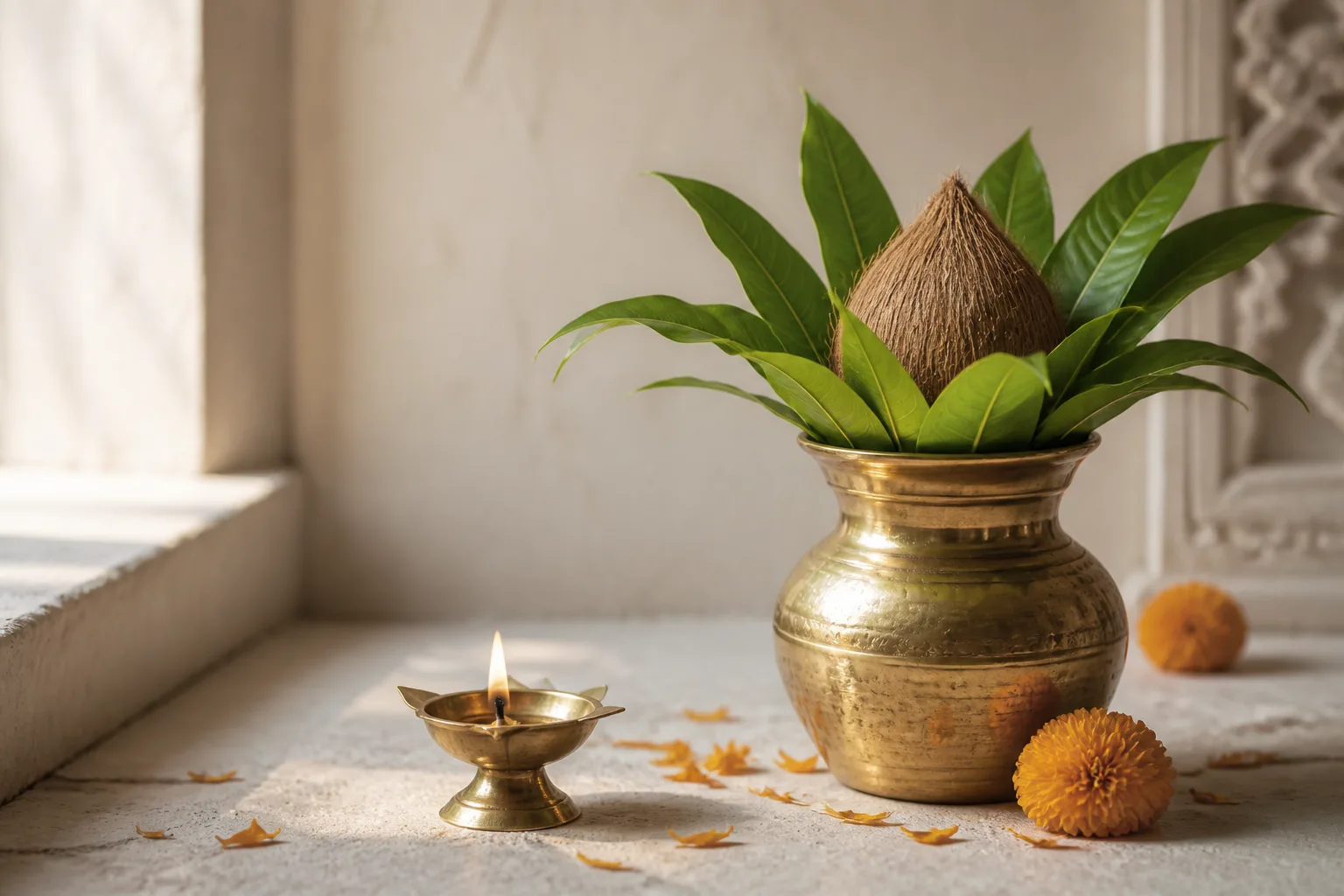
- Daily morning puja. Each of the sixteen days, after a bath, perform the puja: install a Mahalakshmi murti or photograph; place a kalash with water, coin, mango leaves, and coconut; light a ghee diya; offer red flowers, akshat, kumkum.
- Sixteen offerings each day. Each day, offer sixteen of one or more items: sixteen flowers one day, sixteen sweets another, sixteen fruits another, etc. Some traditions prescribe specific offerings for each of the sixteen days corresponding to the sixteen forms of Lakshmi (Adi Lakshmi, Dhana Lakshmi, Dhanya Lakshmi, Gaja Lakshmi, Santana Lakshmi, Vira Lakshmi, Vijaya Lakshmi, Vidya Lakshmi, etc.).
- Recite the Mahalaxmi Stotra. Each day, recite the Sri Mahalaxmi Ashtakam (eight-versed hymn to Mahalakshmi) sixteen times, or the Mahalaxmi Stotram as known to your tradition. Add the Lakshmi Gayatri as opening and closing.
- One sattvik meal each day. Take a single sattvik meal, typically before sunset. Through the sixteen days, abstain from non-vegetarian food, alcohol, onion, garlic, and all rajasic-tamasic foods.
- Do not lose temper, do not speak harshly. The vrat is broken not just by food violations but by harsh speech, anger, or pride. Sustain a quiet, devotional disposition through all sixteen days; this is half the vrat.
Mantras
ॐ श्रीं ह्रीं क्लीं महालक्ष्म्यै नमः
Om Shreem Hreem Kleem Mahalakshmyai Namah
Salutations to Maha Lakshmi.
नमस्ते अस्तु महामाये श्रीपीठे सुरपूजिते । शङ्ख-चक्र-गदाहस्ते महालक्ष्मि नमोस्तुते ॥
Namaste Astu Mahamaye Shreepithe Surapoojite · Shankha-Chakra-Gadahaste Mahalakshmi Namostute
Salutations to you, Maha Lakshmi, great enchantress, seated on the throne of prosperity, worshipped by the gods, holding the conch, the discus, and the mace. (Opening verse of the Sri Mahalaxmi Ashtakam.)
Udyapan — The concluding ceremony
On the sixteenth day (Ashwin Krishna Ashtami), perform the udyapan as the formal closing of the vrat:
— Wake before dawn, take a full bath, wear new clothes (red or yellow are auspicious). Untie the sodasha-granthi thread carefully and place it before Mahalakshmi as part of the offering.
— Set up an elaborate Mahalakshmi puja with all sixteen of the prescribed offerings present at once: sixteen flowers, sixteen fruits, sixteen sweets, sixteen pieces of cloth, sixteen pieces of betel nut, sixteen unbroken whole spices, sixteen of every other prescribed item.
— Perform the full Sri Sukta path (the Lakshmi hymn from the Rig Veda) and the Sri Mahalaxmi Ashtakam. Light sixteen ghee diyas before the murti.
— Invite sixteen brahmins (or, in modern observance, sixteen members of the community regardless of caste). Wash their feet with respect, apply tilak and akshat, and feast them with kheer, halwa, puri, sabzi, and other sattvik dishes prepared in your kitchen with full attention.
— Give each brahmin a small dakshina along with one of the sixteen items prepared in the puja — a piece of cloth, a small steel utensil, kumkum, fruits.
— Donate sixteen of every prescribed item to a Lakshmi temple or to needy families. Donate the sodasha-granthi thread itself either at the temple or to a flowing river.
— Silently complete the sankalpa with which you began the vrat sixteen days ago. Thank Mahalakshmi for whatever has been granted; surrender any remaining anxiety; resolve to maintain a small daily Lakshmi observance (even five minutes of evening puja) for the rest of the year.
— Many devotees follow the udyapan with a pilgrimage to a Mahalakshmi temple — Kolhapur, Shirdi, Tirupati Padmavati shrine, or any major Lakshmi shrine — within a few months as the final thanksgiving.
Maha Lakshmi (Sodasha Lakshmi) seva for Mahalaxmi Vrat (16 days)
The sixteen-day Mahalaxmi vrat invokes Lakshmi in her sixteen forms — Lakshmi archana is the mandir observance that matches the vrat's own worship.
Lakshmi archana performed in your name across the Mahalaxmi 16-day window, with sankalp for abundance and prosperity.
Performed on your next observed Mahalaxmi Vrat (16 days) · sankalp in your name and gotra · photo confirmation after seva
Frequently asked questions
What is the Mahalaxmi Vrat (16 days)?
The Mahalaxmi Vrat is a sixteen-day vrat observed from Bhadrapad Shukla Ashtami to Ashwin Krishna Ashtami in devotion to Maha Lakshmi in her sixteen forms (Sodasha Lakshmi). It is among the most rigorous Lakshmi vrats and is described in the Bhavishya Purana as the vrat Lord Krishna prescribed to Yudhishthira after the Pandavas lost everything in the dyut sabha.
What is the sodasha-granthi thread in Mahalaxmi Vrat?
The sodasha-granthi (sixteen-knot) thread is a sacred raw-cotton thread, dyed turmeric-yellow, with sixteen knots tied in it — each knot consecrated by reciting the Mahalakshmi Gayatri. It is tied on the wrist (right for men, left for women) on the first day of the vrat and worn unbroken for all sixteen days. On the udyapan day, it is untied and offered before Mahalakshmi or in flowing water.
When does Mahalaxmi Vrat 2026 begin?
Mahalaxmi Vrat 2026 begins on Bhadrapad Shukla Ashtami (likely late August / early September 2026) and continues for sixteen days, ending on Ashwin Krishna Ashtami. Verify the exact start date with the Daanyam Panchang for that month — Bhadrapad Shukla Ashtami varies year to year by tithi.
Can men observe the Mahalaxmi Vrat?
Yes. While the vrat is most commonly kept by married women, it is observed by men, married couples, and entire households. The katha itself describes Indra and Yudhishthira observing it. The sankalpa changes by observer — for men typically restoration of finances or career; for women, marital harmony and prosperity; for households, recovery from collective loss.
What is the difference between Mahalaxmi Vrat and Vaibhav Lakshmi Vrat?
The Mahalaxmi Vrat is a sixteen-consecutive-day Bhadrapad observance with the sodasha-granthi thread and sixteen-fold offerings, rooted in the Bhavishya Purana and observed for major restoration of fortune. The Vaibhav Lakshmi Vrat is an eleven-Friday observance, modern in origin (mid-twentieth century), simpler in form, with kheer prasad and a sankalpa for general prosperity. Both honour Mahalakshmi but represent different traditions and intensities.
What if a day is missed during Mahalaxmi Vrat?
Because the vrat is observed on consecutive days from Bhadrapad Shukla Ashtami to Ashwin Krishna Ashtami, a missed day is significant. Traditional teaching is that a single missed day (illness, monthly cycle, unavoidable disruption) is forgivable if compensated by adding an extra day at the end and intensifying the puja for the remaining days. Multiple missed days break the vrat — it must be restarted in the next Bhadrapad.