Free tools
About this vrat
Satyanarayan Vrat Katha (सत्यनारायण व्रत कथा) is among the most widely performed Vishnu pujas across India — observed on any auspicious occasion (Purnima, Sankranti, Ekadashi, the day after a wedding, the day of a housewarming, the first birthday of a child, the launch of a new business) and consisting of an elaborate Vishnu puja followed by the recitation of the five chapters of the Satyanarayan Vrat Katha. The Skanda Purana records the katha in five chapters; tradition holds that hearing the entire katha is itself the central act of the vrat.
Unlike monthly tithi-anchored vrats, Satyanarayan Vrat has no fixed date — it is performed whenever a household chooses to mark an auspicious occasion or to dedicate the merit of a vrat to a specific sankalpa. Purnima (full moon) is the most traditional choice; Pournami Satyanarayan Puja is performed monthly in many traditional households. Ekadashi, Dwadashi, and major Sankrantis are also common.
The unique element of Satyanarayan Vrat is the panchamrita prasad and the sheera (semolina halwa) prasad. The sheera is offered to Vishnu, then distributed to all attendees; tradition holds that anyone who refuses or speaks ill of the sheera prasad will face the kind of difficulties the katha describes. The five chapters of the katha describe successive stories of devotees who observed Satyanarayan with full sincerity (and were rewarded) and of those who broke the vrat or mocked the prasad (and faced consequence).
Satyanarayan Vrat Katha — Katha
The legendary story recited as part of the vrat. Read aloud during the morning puja.
The Satyanarayan Vrat Katha is told in five chapters; here is the essence:
Chapter One — Sage Narada once asked Lord Vishnu what vrat could relieve the sufferings of mortal humans. Vishnu prescribed the Satyanarayan Vrat: a simple Vishnu puja with the recitation of his katha, performed on any auspicious day, with sheera prasad shared. Whoever observes it sincerely receives the fulfilment of any righteous sankalpa.
Chapter Two — A poor brahmin named Sadananda heard of the vrat and observed it on the next Purnima. His poverty dissolved within days; he became prosperous; his household became known for its hospitality. A wood-cutter, observing Sadananda's transformation, asked him about the vrat; the brahmin taught it to him; the wood-cutter himself observed it and rose to prosperity. Both maintained the annual Satyanarayan Puja for the rest of their lives.
Chapter Three — A merchant named Sadhuvaniya, having no children, was advised to observe Satyanarayan with his wife Lilavati. They observed it; soon a daughter Kalavati was born to them. The merchant promised to perform a special Satyanarayan when his daughter would marry; he forgot the promise after Kalavati's wedding. The promise broken, his ship was lost at sea; he was imprisoned by a king who falsely accused him of theft. Only when Lilavati and Kalavati performed Satyanarayan in his name, fulfilling the broken promise, was the merchant released and his ship recovered.
Chapter Four — The merchant, restored, returned to Kalavati's home but at first refused to take the prasad of the Satyanarayan that Lilavati and Kalavati were performing in his name. The Satyanarayan immediately disappeared from the wedding celebration; problems arose for the family. Only when the merchant accepted and ate the sheera prasad did the difficulties resolve.
Chapter Five — Once, in a forest, a group of cowherd boys were observing Satyanarayan with simple offerings of leaves, flowers, and a portion of their meal. A king passed by; he saw their puja but treated it with disdain, refusing to participate. His chariot's wheels stuck; his army faced obstacles; he could not move forward. Only when he humbly returned to the cowherd boys, accepted their prasad, and joined their puja, did his journey become possible.
Each chapter teaches the same essential principle: Satyanarayan Vrat is generous beyond measure to those who observe it sincerely; but the prasad must not be refused, the promise must not be broken, the puja must not be mocked. The katha closes with the affirmation that whoever sincerely performs Satyanarayan, listens to all five chapters, and shares the sheera prasad with every attendee receives the protection of Lord Satyanarayan upon themselves and their household.
Vrat Vidhi — How to observe
- Choose an auspicious occasion. Purnima is most traditional; Ekadashi, Sankranti, or any household milestone (marriage anniversary, housewarming, child's first birthday, business launch) is also valid.
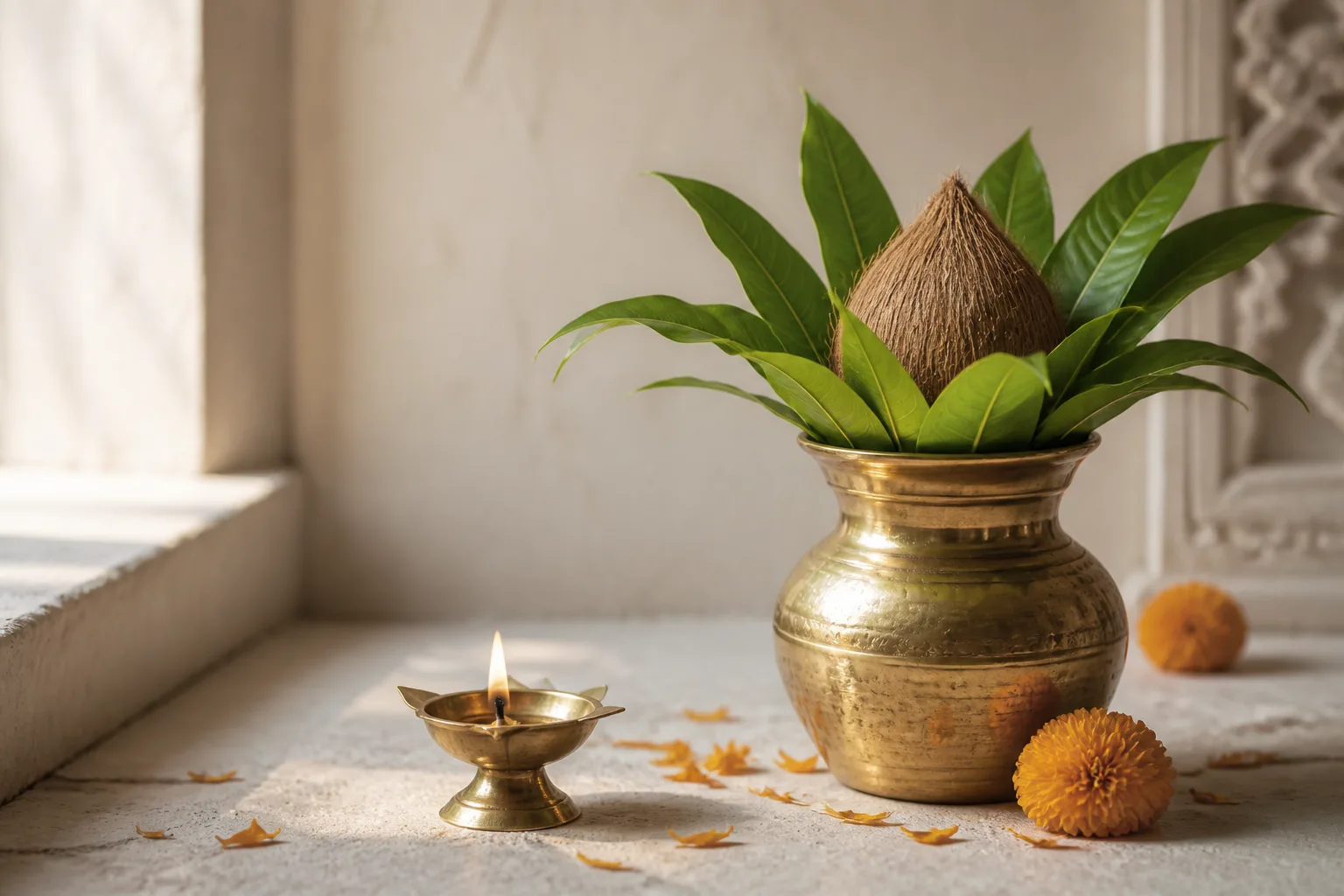
- Set up an elaborate Vishnu puja. Place a Vishnu murti or photograph on a clean cloth (yellow). Set up a kalash with water, mango leaves, coconut, and a coin. Banana leaves around the puja area are traditional.
- Invite a brahmin (where possible). A learned brahmin to lead the puja and the recitation of the katha is the most traditional form. Where not possible, the head of the household reads the katha; many printed Satyanarayan Vrat Katha booklets are widely available.
- Perform standard Vishnu puja. Offer tulsi, yellow flowers, akshat, fruit, panchamrita (a mixture of milk, curd, ghee, honey, and sugar). Light ghee diyas.
- Read all five chapters of the katha. This is the central act of the vrat. Read aloud in full so all family members and attendees can hear. Do not skip chapters; do not abbreviate.
- Prepare and offer sheera (semolina halwa). This is the unique prasad of the vrat. Sheera is made with sooji (semolina), ghee, sugar, milk, and dry fruits. Offer it at Vishnu's feet first; then distribute to all attendees.
- No one refuses the sheera prasad. This is critical — per the katha (chapters three, four, and five), refusing the prasad invites difficulty. Every attendee should take at least a small portion.
- Conclude with aarti. Perform a final aarti before Vishnu. Distribute final prasad. The puja is complete.
Mantras
ॐ नमो भगवते वासुदेवाय
Om Namo Bhagavate Vasudevaya
Salutations to the divine Vasudeva.
ॐ सत्य नारायणाय नमः
Om Satya Narayanaya Namah
Salutations to Lord Satyanarayan — the Lord of Truth.
Udyapan — The concluding ceremony
Satyanarayan Vrat Katha is itself a complete observance — every performance is its own udyapan. There is no separate closing ceremony for the vrat. Many households perform it monthly on Purnima as ongoing ritual; others perform it annually on a household milestone date; others perform it whenever a major sankalpa requires consecration.
Lord Satyanarayan (Vishnu) seva for Satyanarayan Vrat Katha
Satyanarayan Katha honours Vishnu as the Lord of Truth — Vishnu archana carries the katha's own prayer into temple seva.
Vishnu archana performed in your name on the day of your Satyanarayan Katha, with sankalp for truth and prosperity.
Performed on your next observed Satyanarayan Vrat Katha · sankalp in your name and gotra · photo confirmation after seva
Frequently asked questions
What is Satyanarayan Vrat Katha?
Satyanarayan Vrat Katha is among the most widely performed Vishnu pujas across India. It consists of an elaborate Vishnu puja followed by the recitation of the five chapters of the Satyanarayan Vrat Katha (drawn from the Skanda Purana) and the sharing of sheera (semolina halwa) prasad. The vrat has no fixed date — it is performed on any auspicious occasion: Purnima, Ekadashi, household milestones, or major decisions.
When should I perform Satyanarayan Vrat?
Purnima (full moon) is most traditional; many households perform it monthly on Pournami. Other auspicious occasions include Ekadashi, Sankranti, the day after a wedding, a housewarming, a child's first birthday, the launch of a new business, an anniversary, or any major life decision. Choose any auspicious time that matches your sankalpa.
Why must everyone eat the sheera prasad?
Per the katha (chapters three, four, and five), refusing the sheera prasad invites difficulty — the merchant who refused his wife's prasad faced renewed difficulties; the king who refused the cowherd boys' prasad was unable to continue his journey. Sheera is the central prasad of the vrat; every attendee must take at least a small portion. The sharing-and-acceptance is itself part of the vrat.
What are the five chapters of the Satyanarayan Vrat Katha?
Chapter 1: Narada asks Vishnu about the vrat; Vishnu prescribes it. Chapter 2: A poor brahmin and a wood-cutter observe the vrat and prosper. Chapter 3: A childless merchant and his wife observe the vrat and have a daughter; the merchant later breaks his promise to perform a special Satyanarayan and faces difficulty. Chapter 4: The merchant, restored, refuses the prasad and faces renewed problems; only acceptance resolves them. Chapter 5: Cowherd boys' simple Satyanarayan, mocked by a king, teaches the lesson of humility before the vrat.
Can a household perform Satyanarayan Vrat without a brahmin?
Yes. While a learned brahmin to lead the puja is most traditional, many households perform Satyanarayan with the head of the household leading the puja and reading the katha. Many printed booklets and audio recordings of the katha are widely available. The essential acts — the Vishnu puja, the reading of all five chapters, the offering and sharing of sheera prasad — can all be performed by family members directly.
What is the difference between Purnima Vrat and Satyanarayan Vrat?
Purnima Vrat is the simpler full-moon Vishnu observance — fasting, light puja, recitation of Vishnu's name. Satyanarayan Vrat is the more elaborate observance with the five-chapter katha, sheera prasad, and full Vishnu puja. Many households perform Satyanarayan on the Purnima itself, combining both observances.