Free tools
About this vrat
Ravivar Vrat (रविवार व्रत) is the weekly Sunday vrat dedicated to Lord Surya, the Sun-god — the deva who gives life, health, sight, and dignity to all beings on earth. Sunday in the Hindu week is the day of Surya through its planetary association: the day of self-radiance, of leadership, of physical health and visual clarity, and of the cultivation of the inner light that mirrors the outer Sun.
The vrat is among the oldest in the Hindu calendar, with references in the Brahma Purana, the Bhavishya Purana, and the entire Aditya-Hridayam tradition that flowered through the bhakti movement. It is observed by those seeking relief from skin or eye afflictions, by leaders seeking the dignity and clarity that Surya embodies, by those with weak Surya in their natal chart (causing low confidence, weak immunity, or difficulties with father-figure relationships), and by anyone seeking the slow, steady cultivation of inner radiance that comes from the Sun's daily worship.
The form is bright and disciplined. Sunday morning involves a pre-dawn bath, the offering of arghya (water from a copper vessel) to the rising Sun, the recitation of the Aditya Hridaya Stotra, and a single meal of food that has been cooked only once. Red is the colour of the day; copper is the metal; ruby is the gemstone; wheat and jaggery are the offerings; and the central discipline is the avoidance of salt — many traditional observers eat their Sunday meal entirely without salt, a mark of Surya's tapasya.
Ravivar Vrat — Katha
The legendary story recited as part of the vrat. Read aloud during the morning puja.
The Ravivar Vrat Katha is the story of an old woman named Sushila who lived alone in a small house at the edge of a village. Sushila was extremely poor — her only possession was a single cow that gave her milk. But she was deeply pious and devoted to Lord Surya from her earliest years. Every Sunday morning, before sunrise, Sushila would bathe, sweep her courtyard with cow-dung paste, draw a small mandala, set out a copper vessel of water, and offer arghya to the rising Sun with full sincerity. She would prepare a small portion of kheer with the milk her cow gave her, offer a small portion of it to Surya, then eat a single meal in the evening — a meal cooked only once, without salt, in honour of Surya.
A neighbour, who was wealthy but prone to envy, watched Sushila's quiet devotion year after year and began to grow jealous. The neighbour herself had everything Sushila lacked — wealth, a large family, social respect — but she did not have Sushila's serenity. She grew increasingly bitter and one day said to Sushila: "What is the point of your daily offerings? You are still poor, your cow is old, your house is small. Your Surya does not give you anything."
Sushila answered gently: "Sister, Surya gives me what no one can take away. He gives me the strength to wake before dawn, the breath in my lungs, the sight in my eyes. The kheer I offer him each Sunday is the mark of my gratitude — not the price of his grace."
The neighbour, dissatisfied, decided to sabotage Sushila's vrat. The next Sunday, while Sushila was at the river bathing, the neighbour entered Sushila's courtyard and let her own cow loose into Sushila's mandala — the cow trampled the swept area, knocked over the copper vessel, and ate the small portion of grass Sushila had set out. When Sushila returned, she saw what had happened. She did not weep; she did not get angry; she swept the courtyard again, drew a new mandala, set up the copper vessel with whatever water she had, and offered the arghya. The kheer that Sushila had prepared was lost; she offered Surya only her hands joined in salutation, and said: "Lord, today I have nothing to offer you but my devotion. Accept it as it is."
That same evening, Sushila's old cow — who had been sickly for some weeks — was suddenly restored to full health. Her milk became sweeter and more abundant. The next morning, a stranger came to Sushila's door — a wealthy merchant from a distant city — who had been told in a dream to find an old woman named Sushila in this very village and to commission her cow's milk for a special preparation he was undertaking for the local king. The merchant offered Sushila a generous fee for a year's supply of milk. Sushila accepted. Within months, she was no longer poor — but she continued to live in the same small house, to perform the same Ravivar Vrat each Sunday, and to give the first portion of every meal to anyone who came to her door.
The neighbour, watching Sushila's prosperity, was at first more bitter, then curious, then ashamed. She came to Sushila and confessed that she had been the one who had let the cow into the mandala. Sushila smiled and said: "Sister, I knew. But Surya himself accepted my offering of empty hands; that morning when I had nothing to give him was the morning he gave me everything. Begin your own Ravivar Vrat. But begin it not for what Surya will give you — begin it for who Surya will help you become."
The neighbour, now humble, began the vrat. She observed it for a year with full sincerity. By the year's end, her bitterness had dissolved; her household had become peaceful; her own children had begun to look up to her with respect rather than fear. She came to Sushila on the last Sunday of the year and said: "I understand now. Surya does not give wealth — Surya gives the soul that is worth a household."
The katha closes with the affirmation that Ravivar Vrat is the simplest and most demanding of vrats. The form is small — pre-dawn bath, arghya, a single meal. The discipline is the heart-position: rising before the Sun, offering even when there is nothing to offer, holding gratitude as the foundation rather than as the result. Whoever observes it with that disposition receives Surya's slow, steady cultivation of inner radiance — health, dignity, clarity, leadership — across years.
Vrat Vidhi — How to observe
- Wake before sunrise. Bathe in pure water; if possible, with a small amount of Ganga jal added. Wear clean clothes (red, orange, or saffron are auspicious for Surya).
- Sweep the courtyard. Sweep the puja area (or your home's main entry) clean. Many traditional homes sprinkle a small amount of cow-dung paste on Sunday morning, though this is increasingly impractical in modern homes — water with a few drops of Ganga jal is an acceptable substitute.
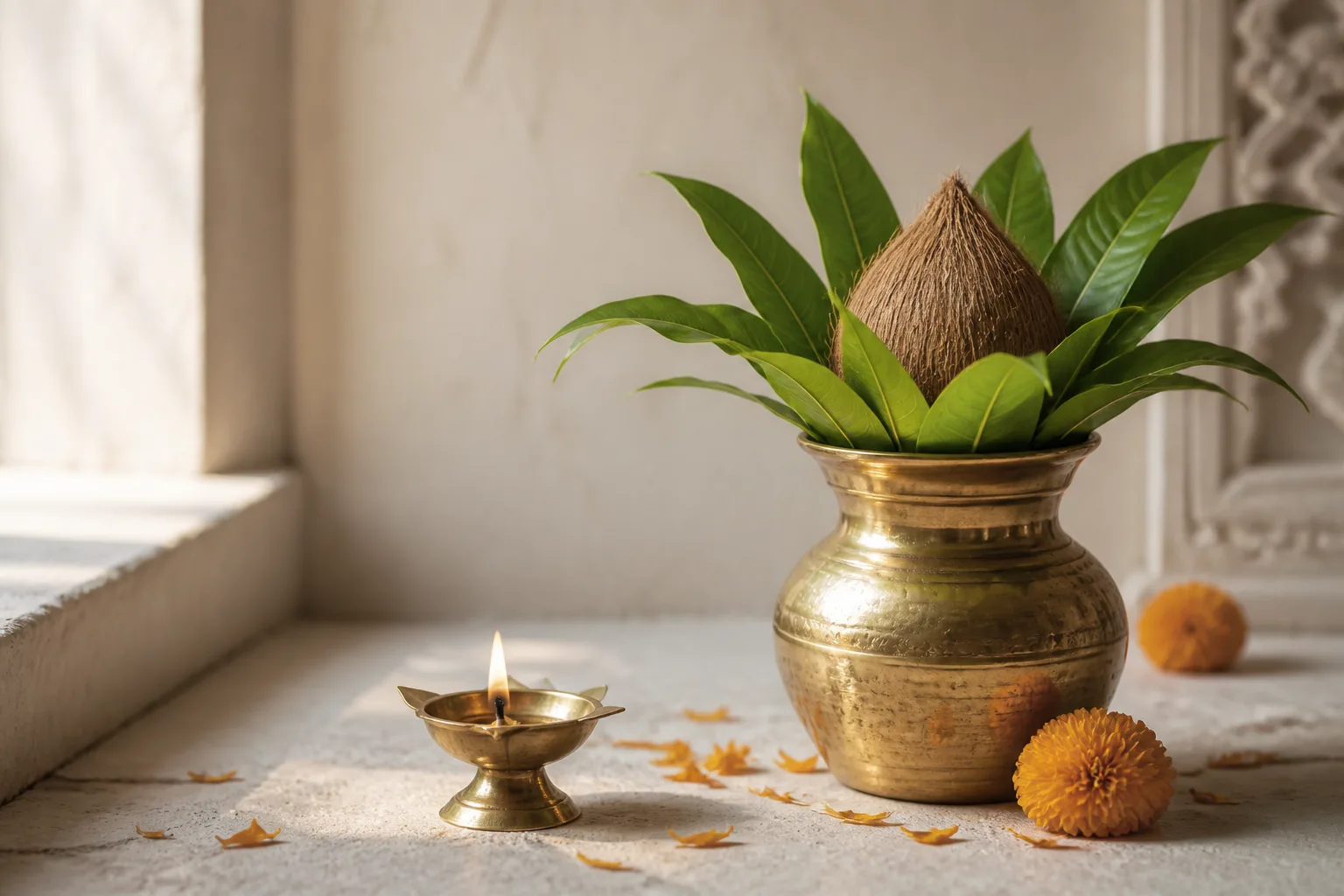
- Set up the copper vessel. Fill a copper vessel with water; add a few red flowers, a piece of jaggery (gur), kumkum, and akshat. Stand facing east as the Sun rises.
- Offer arghya to the rising Sun. Pour the water from the copper vessel slowly onto the ground, in a thin stream, while looking at the rising Sun through the water (the water acts as a refractive medium that allows you to look at the Sun safely). This is the central act of the vrat. Recite "Om Suryaya Namah" or the Surya Gayatri while pouring.
- Recite the Aditya Hridaya Stotra. This stotra (taught by sage Agastya to Lord Rama before his battle with Ravana, recorded in the Yuddha Kand of the Valmiki Ramayana) is the most powerful Sunday recitation. Add the Surya Mantra "Om Suryaya Namah" 108 times.
- Single meal of once-cooked food, without salt. Take one meal during the day. The meal should be cooked only once (no leftovers warmed; nothing reheated). Most traditional observers omit salt entirely; many also omit oil. Wheat-based items (roti, halwa) are favoured for their Surya-association. No onion, garlic, meat, or alcohol.
- Wear or carry red. A red thread on the wrist, a small piece of red cloth on the puja chowki, or a ruby (where worn) is the traditional Surya-day adornment.
- Repeat every Sunday. For a specific sankalpa, observe one full year (52 Sundays) of weekly Ravivar Vrat with the udyapan in the 53rd week. For ongoing devotion, observe weekly.
Mantras
ॐ सूर्याय नमः
Om Suryaya Namah
Salutations to Lord Surya. (The Surya Mantra.)
ॐ आदित्याय विद्महे दिवाकराय धीमहि । तन्नः सूर्यः प्रचोदयात् ॥
Om Adityaya Vidmahe Divakaraya Dheemahi · Tannah Suryah Prachodayat
We meditate upon Lord Aditya, the maker of day — may Surya illumine our minds. (The Surya Gayatri.)
Udyapan — The concluding ceremony
For a one-year (52-Sunday) observance, perform the udyapan as follows:
— On the fifty-second Sunday or the first Sunday after — typically on a Sunday near a major solar event (Makar Sankranti, Mesha Sankranti, or any Surya-puja day) — perform an elaborate Surya puja: a special pre-dawn bath in flowing water (river, well, or with substantial Ganga jal), arghya offered with twelve full circumambulations, the Aditya Hridaya Stotra recited twelve times, the Surya Sahasranama recited where possible.
— Invite twelve brahmins (or twelve community members) — twelve for the twelve forms of Aditya. Feed them a meal of once-cooked food, without salt: roti, halwa, kheer, plain sabzi, wheat-based items. Give each a small dakshina along with red cloth and a copper item.
— Donate twelve of every red or copper item — twelve pieces of red cloth, twelve copper utensils, twelve units of wheat — to a Surya temple or to needy families.
— Visit a major Surya temple if possible — Konark Sun Temple in Odisha, Modhera Sun Temple in Gujarat, or any local Surya shrine. Offer water, jaggery, and red flowers there.
— Silently complete the sankalpa with which you began. Resolve to maintain at least the morning arghya practice — pouring water from a copper vessel toward the rising sun, with "Om Suryaya Namah" — every Sunday for the rest of the year.
Lord Surya (Aditya) seva for Ravivar Vrat
Sunday is Surya's day — archana on this vrat carries the prayer for health, vitality, and the Sun's blessings.
Surya archana performed in your name on a Sunday, with sankalp for health and vitality.
Performed on your next observed Ravivar Vrat · sankalp in your name and gotra · photo confirmation after seva
Frequently asked questions
What is Ravivar Vrat?
Ravivar Vrat is the weekly Sunday vrat in devotion to Lord Surya (the Sun) and Aditya (Surya's twelve forms). It is observed for health, eyesight, leadership and dignity, recovery from skin and bone afflictions, and relief from Surya-related afflictions in the natal chart. The form involves a pre-dawn bath, the offering of arghya from a copper vessel to the rising Sun, recitation of the Aditya Hridaya Stotra, and a single meal of once-cooked food, often without salt.
How is the arghya to Surya offered?
Stand facing east as the Sun rises. Hold a copper vessel filled with water mixed with a few red flowers, a piece of jaggery, kumkum, and akshat. Pour the water slowly in a thin stream onto the ground while looking at the rising Sun through the water (the water refracts the sunlight, making it safe to look). Recite 'Om Suryaya Namah' or the Surya Gayatri as the water pours. This is the central act of every Sunday observance.
Why is salt avoided on Sundays during Ravivar Vrat?
Salt avoidance on Sundays is the specific dietary tapas of the vrat. The traditional explanation is that salt is rajasic and disturbs the sattvic state Surya's grace requires; avoiding it on his day is an act of mindful restraint. Strict observers also omit oil from the Sunday meal. The discipline is observed for the duration of the vrat — typically one year for a specific sankalpa, or for life as ongoing tapas.
Can Ravivar Vrat help with eye problems or skin afflictions?
Yes — the vrat is traditionally observed for relief from eye and skin afflictions, both of which are associated with Surya in Vedic medicine and astrology. The combination of weekly Surya observance, the daily-or-weekly arghya practice, and the donation of wheat, jaggery, and red cloth to those in need is considered the standard remedial measure. The vrat is generally observed for at least one year for chronic conditions.
Why is copper used for the arghya vessel?
Copper is Surya's metal. The Atharva Veda associates copper with solar energy and with the cultivation of inner radiance. A copper vessel held in sunlight is said to activate Surya's energy in the water it contains; the water poured as arghya then carries that solar charge to the earth and back to the Sun in the offering. Modern devotees who have access to copper vessels strongly favour them; brass or steel are acceptable substitutes where copper is not available.
Should I observe Ravivar Vrat if I have weak Surya in my chart?
Yes — relief from Surya-related afflictions (a weak Sun in the natal chart, Surya Mahadasha difficulties, low confidence, weak immunity, difficulties with father-figure relationships) is one of the traditional purposes of the vrat. The combination of weekly observance, the daily arghya practice, the recitation of the Aditya Hridaya, and the donation of red cloth, copper, and wheat is considered the most effective remedial practice for Surya-related issues in the chart.