Free tools
About this vrat
Sashthi Vrat (षष्ठी व्रत) is the monthly Shukla Sashthi (6th tithi) vrat dedicated to Lord Skanda — also called Karthikeya, Subramanya, and Murugan. Skanda is the second son of Shiva and Parvati, the deva of valour and the slayer of the asura Tarakasura; his most prominent worship is in south India (where he is the central deity of Tamil bhakti tradition and is venerated at the six great Murugan temples), but his Sashthi Vrat is observed widely across India — particularly by mothers seeking the protection and healing of their children.
The Skanda Sashthi — observed for six consecutive days from Ashwin Shukla Pratipada to Ashwin Shukla Sashthi (typically October) — is the most concentrated Skanda observance of the year. The monthly Sashthi Vrat is a smaller version of the same devotional pattern: a single-day fast, worship of Skanda with red flowers and ghee diyas, recitation of the Subramanya Bhujangam (composed by Adi Shankaracharya), and the offering of vibhuti (sacred ash) prasad.
The vrat is particularly observed for children: when a child is ill, when a child faces difficulty in studies or sport, when a child needs protection from any threat. Skanda is the deva of healthy children — born himself from the divine fire to defeat a great asura, he is the protector of every child who turns to him.
Sashthi Vrat — Katha
The legendary story recited as part of the vrat. Read aloud during the morning puja.
The Sashthi Vrat Katha is the story of Devasena, daughter of King Indra, who was the consort of Lord Skanda. The asura Tarakasura — through long tapasya — had received from Brahma a boon that he could be killed only by a son of Shiva. Tarakasura, knowing that Shiva had withdrawn into deep meditation after the death of Sati and would not have a son, considered himself effectively immortal. He attacked the heavens; he drove out Indra; he became the terror of all three worlds.
The gods, in despair, came to Brahma and asked for relief. Brahma said: "Only a son of Shiva can kill Tarakasura. Shiva is in deep meditation at Mount Kailash; we must rouse him." The gods sent Kamadeva — the god of love — to disturb Shiva's meditation; Shiva, enraged at being disturbed, opened his third eye and burned Kamadeva to ashes. But the disturbance had its effect; Shiva began to look at Parvati, who had been performing tapasya for him through Kamadeva's intervention, with eyes of love. They were married; they had a son.
That son was Skanda. He was born not from the womb but from the divine fire — Shiva's seed, carried by Agni and the Krittika nakshatra (the six stars who became his foster-mothers, giving him the alternate name Karthikeya — "the one nourished by the Krittikas"). Skanda grew at extraordinary speed; by the sixth day from his birth — Shukla Sashthi — he was old enough to bear weapons. The gods, watching his birth, gathered on Sashthi to celebrate the imminent defeat of Tarakasura.
Skanda, mounted on his peacock vahana, led the celestial army into battle. Tarakasura — who had been undefeated for ages — fell to Skanda's spear (the Vel) on the sixth day of battle. The heavens were restored; Indra was returned to his throne. Indra, in gratitude, offered his daughter Devasena to Skanda as his consort. The marriage was performed; Skanda took residence at Tiruchendur on the southern coast, where the great Murugan temple still stands.
Indra then declared: "From this day, the Shukla Sashthi of every month shall be Skanda Sashthi — the day of Skanda's birth-from-fire and his victory over Tarakasura. Whoever observes the Sashthi Vrat on this day with full sincerity shall receive Skanda's protection — particularly mothers seeking the protection of their children, and warriors seeking victory over their enemies."
The katha closes with the affirmation that Sashthi Vrat — particularly when observed monthly — anchors a household in Skanda's protective grace. Whoever observes it for the protection of a child finds Skanda standing as the elder brother who defended his mother Parvati against the asuras, willing to defend any child whose mother turns to him.
Vrat Vidhi — How to observe
- Identify the Shukla Sashthi. Verify the tithi with the Daanyam Panchang.
- Pre-dawn bath. Wear clean clothes (red is auspicious for Skanda).
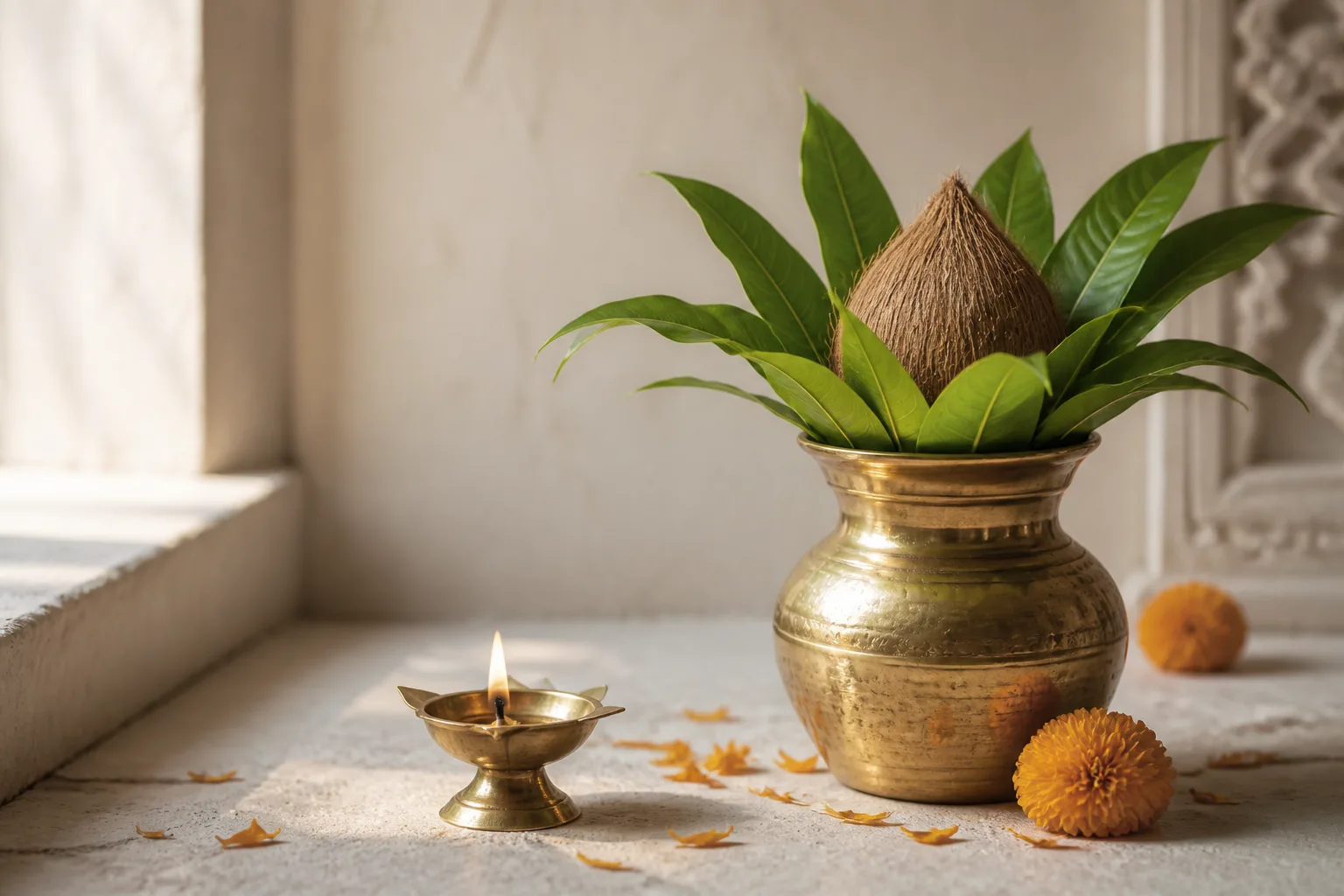
- Set up Skanda puja. Place a Skanda/Karthikeya/Murugan murti or photograph. Offer red flowers (especially hibiscus), red sandalwood, akshat, and a piece of yellow cloth. Light a ghee diya.
- Offer vibhuti and the Vel. Apply vibhuti (sacred ash) to the murti's forehead. Where a small Vel (spear) symbol is available, place it before the murti.
- Recite the Subramanya Bhujangam. Composed by Adi Shankaracharya, this stotra is the most powerful Skanda recitation. Add 'Om Saravana Bhava' 108 times.
- Hold the sankalpa for protection. If observing for a child, hold the child's name silently. If for victory in conflict, hold the specific situation.
- Single sattvik meal. Take one sattvik meal during the day.
Mantras
ॐ शरवण भव
Om Saravana Bhava
Salutations to the one born in the Saravana reed-grove. (The Skanda Beej Mantra.)
ॐ सुब्रह्मण्याय नमः
Om Subramanyaya Namah
Salutations to Subramanya.
Udyapan — The concluding ceremony
Sashthi Vrat has no formal udyapan as a monthly observance. Devotees who observe it for a full year often mark the milestone with a pilgrimage to one of the six great Murugan temples (Arupadai Veedu) in Tamil Nadu — Palani, Swamimalai, Tiruchendur, Pazhamudircholai, Thiruparankundram, or Tiruttani. The Skanda Sashthi (six-day Ashwin observance) is itself often used as the annual closing for monthly Sashthi observers.
Vishnu seva for Sashthi Vrat
Temple seva on this vrat carries the merit of traditional observance when performed in your name.
Archana at a verified mandir on your vrat day, with sankalp and photo confirmation.
Performed on your next observed Sashthi Vrat · sankalp in your name and gotra · photo confirmation after seva
Frequently asked questions
What is Sashthi Vrat?
Sashthi Vrat is the monthly Shukla Sashthi (6th tithi) vrat dedicated to Lord Skanda — Karthikeya, Subramanya, Murugan. It is observed for the protection of children, victory over enemies, healing of childhood illnesses, and the cultivation of valour. Skanda is the second son of Shiva and Parvati, born to defeat the asura Tarakasura.
What is Skanda Sashthi?
Skanda Sashthi is the six-day Skanda observance from Ashwin Shukla Pratipada to Ashwin Shukla Sashthi (typically October), commemorating Skanda's six-day battle that ended in the defeat of Tarakasura. It is the most concentrated Skanda observance of the year and is celebrated with great elaboration at Murugan temples in Tamil Nadu.
Why is Sashthi Vrat associated with the protection of children?
Skanda is the deva of healthy children — born himself from divine fire and nurtured by the six Krittika foster-mothers, he is intimately associated with the divine protection of childhood. Mothers seeking the healing of a sick child, the protection of a child in difficulty, or the wellbeing of a newborn traditionally turn to Sashthi Vrat as the most powerful monthly observance for these intentions.
What is the Vel and why is it associated with Skanda?
The Vel is Skanda's divine spear — the weapon with which he killed Tarakasura. In south Indian tradition, the Vel is itself worshipped as a form of Skanda; pilgrimages to the six great Murugan temples include offerings to the Vel. In the home, a small Vel-symbol placed at the puja chowki on Sashthi Vrat day is the most traditional offering.
Where is Sashthi Vrat most prominently observed?
Tamil Nadu is the heart of Skanda-bhakti tradition; the six great Arupadai Veedu Murugan temples (Palani, Swamimalai, Tiruchendur, Pazhamudircholai, Thiruparankundram, Tiruttani) are the central pilgrimage destinations. Sashthi Vrat is observed widely in Tamil and Malayalee homes, in the Tamil and Sri Lankan diaspora globally, and increasingly across north India by devotees who have encountered the tradition.
When is the next Sashthi Vrat?
Sashthi Vrat occurs once a month on Shukla Sashthi. Verify the next date with the Daanyam Panchang.